Best Agentic AI Platforms in 2026
Explore the best agentic AI platforms in 2026. Compare Calljmp, Agno, Mastra, LangChain, and more — and learn how modern AI agents are built, orchestrated, and run in production.

A Practical Guide to Building Multi-Step AI Systems
TL;DR
In 2026, the most advanced AI products are no longer built with single LLM calls or simple automations. They are built with agentic AI platforms — systems that plan, reason, use tools, manage memory, and run long-lived workflows. This article compares the leading agentic AI platforms and explains why Calljmp represents a new generation of agentic infrastructure.
AI Orchestration Has Entered the Agentic Era
Over the past two years, AI orchestration has shifted dramatically.
Early AI integrations focused on:
- prompt templates
- one-off LLM calls
- basic workflow chaining
By 2026, this approach no longer scales.
Modern AI systems must:
- reason across multiple steps
- retrieve and compress context dynamically
- invoke tools and APIs safely
- persist state across minutes, hours, or days
- pause for human input and resume execution
- operate inside real products, not demos
This shift has given rise to a new category: agentic AI platforms.
What Is an Agentic AI Platform?
An agentic AI platform provides the infrastructure required to run AI agents as persistent, stateful systems, not just scripts or prompts.
Core capabilities typically include:
- multi-step planning and execution
- tool and API invocation
- memory and context management
- state persistence
- retries, fallbacks, and safeguards
- observability (logs, traces, cost tracking)
- integration with application backends
Unlike workflow builders or prompt frameworks, agentic platforms are designed to run AI as part of your application logic.
Evaluation Criteria for Agentic AI Platforms (2026)
When comparing agentic AI platforms, teams typically evaluate them across the following dimensions:
- Execution model – short vs long-running agents
- State & memory – how context is stored and retrieved
- Tool orchestration – reliability, validation, retries
- Runtime management – hosting, scaling, execution guarantees
- Observability – logs, traces, errors, cost visibility
- Developer experience – code-first vs configuration-heavy
- Production readiness – security, isolation, governance
With these criteria in mind, let’s review the leading platforms.
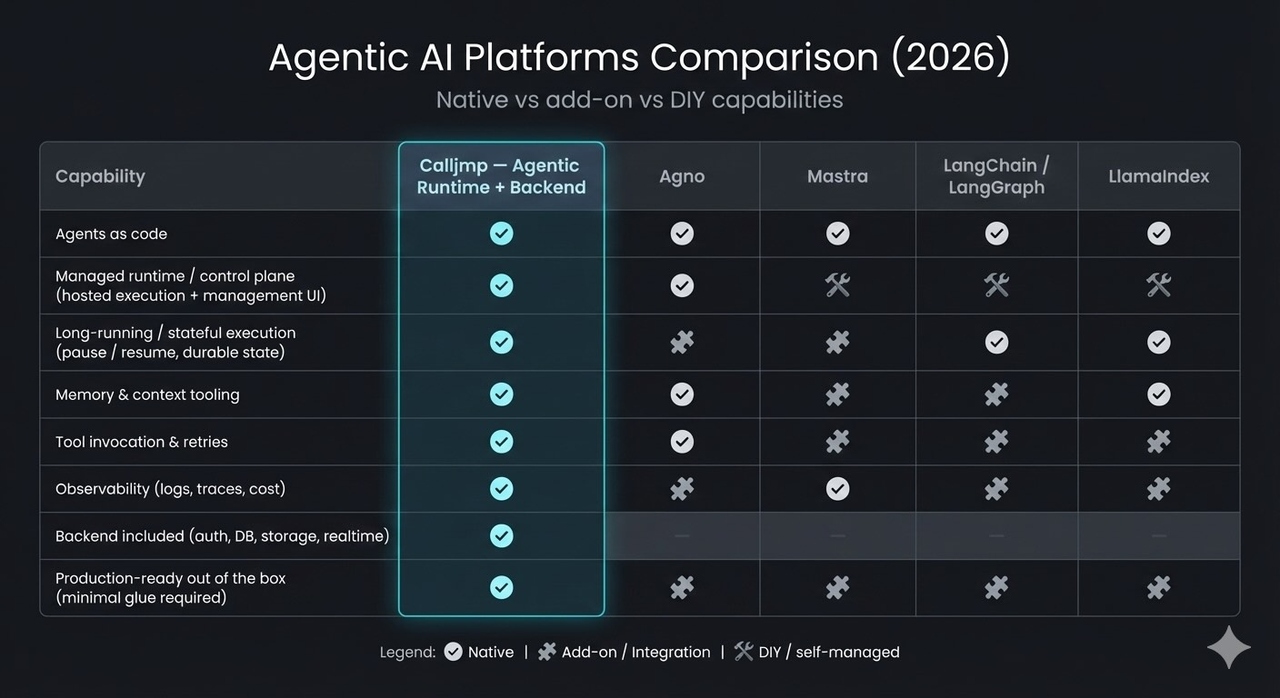
Best Agentic AI Platforms in 2026
1. Calljmp — Agentic AI as TypeScript Code
Calljmp represents a new class of agentic platforms: agents as code with a fully managed runtime.
Instead of treating agents as prompts or visual flows, Calljmp lets developers define agents directly in TypeScript, alongside application logic.
Key strengths:
- Agents written as TypeScript functions
- Long-running execution with persisted state
- Built-in memory, context compression, and retrieval
- Reliable tool invocation with retries and validation
- Human-in-the-loop pause/resume
- Full backend included (auth, database, storage, realtime events)
- Zero-config observability: logs, traces, errors, costs
- Edge-native execution without infrastructure management
Best for
SaaS companies, mobile apps, internal platforms, and teams embedding AI deeply into their products.
Key distinction
Calljmp is not just an orchestration framework — it is a managed agentic runtime plus backend, designed to make AI agents a first-class part of production systems.
2. Agno — Enterprise Agentic Automation
Agno focuses on structured, enterprise-grade agentic workflows.
Strengths:
- Role-based agent design
- Enterprise alignment
- Stability for operational use cases
Limitations:
- Less flexible for deeply embedded product logic
- Heavier enterprise orientation
Best for
Large organizations automating internal processes with defined agent roles.
3. Mastra — Open-Source Agent Framework
Mastra is a developer-friendly, open-source framework for building AI agents.
Strengths:
- Code-first approach
- Open-source flexibility
- Good for experimentation
Limitations:
- No managed runtime
- Hosting, scaling, and observability handled by the user
Best for
Teams that want full control and are willing to manage infrastructure.
4. Contextual_ai — Context Engineering for Agents
Contextual_ai focuses heavily on context management, retrieval, and grounding.
Strengths:
- Advanced context engineering
- Strong RAG-oriented capabilities
Limitations:
- Not a full agent runtime
- Limited execution and orchestration features
Best for
Knowledge-intensive systems where context quality is critical.
5. Fixie_ai — Enterprise AI Agents
Fixie_ai targets enterprise conversational agents and internal automation.
Strengths:
- Prebuilt enterprise integrations
- Focus on reliability
Limitations:
- Limited programmability compared to code-first platforms
Best for
Enterprises deploying standardized AI assistants.
6. LangChain — Agent Framework, Not a Runtime
LangChain remains one of the most popular agent frameworks.
Strengths:
- Large ecosystem
- Flexible building blocks
Limitations:
- Framework only — no runtime
- Requires significant glue code
- Production concerns handled externally
Best for
Prototyping and experimentation rather than full production systems.
7. LlamaIndex — Context Pipelines for Agents
LlamaIndex excels at retrieval, indexing, and context pipelines.
Strengths:
- Strong document processing
- Flexible data connectors
Limitations:
- Not a complete agent orchestration platform
- No execution runtime
Best for
RAG-heavy applications where retrieval is the primary concern.
Agentic AI Platforms Compared
| Platform | Managed Runtime | Memory & State | Observability | Backend Included | Best Use Case |
|---|---|---|---|---|---|
| Calljmp | Native | Native | Native | Native | Embedded AI systems |
| Agno | Native | Native | Add-on | No | Enterprise automation |
| Mastra | DIY | Native | Native | No | OSS / custom stacks |
| Contextual_ai | Add-on | Native | Add-on | No | Context-heavy AI systems |
| Fixie_ai | Native | Limited | Add-on | No | Enterprise assistants |
| LangChain / LangGraph | DIY | Add-on | Add-on | No | Custom agent stacks |
| LlamaIndex | DIY | Native | Add-on | No | RAG pipelines |
Why Calljmp Stands Out in 2026
Calljmp addresses a fundamental gap in the AI ecosystem: frameworks help you build agents, but they don’t help you run them.
Calljmp combines:
- agent definition
- execution runtime
- backend services
- observability
- cost and reliability controls
into a single, developer-first platform.
This allows teams to:
- treat AI agents like backend services
- ship faster with fewer moving parts
- avoid stitching together frameworks, cloud services, and monitoring tools
- evolve agents safely over time
In practice, this means less glue code, fewer failure points, and faster iteration.
When an Agentic Platform Is the Right Choice
Agentic AI platforms are the right choice when:
- AI logic spans multiple steps
- context must persist over time
- agents interact with real systems
- human review is required mid-execution
- reliability and observability matter
- AI is embedded into a product, not bolted on
In these scenarios, agentic platforms outperform prompt-based or workflow-based solutions by design.
Final Thoughts
By 2026, AI orchestration is no longer about chaining prompts. It is about running intelligent systems.
Agentic AI platforms make this possible, and among them, Calljmp stands out by combining:
- agents as TypeScript code
- a managed execution runtime
- a built-in backend
- first-class observability
For teams building production-grade AI systems, agentic platforms are no longer optional — they are foundational.