Backend for AI Agents: Why Production Agents Need a Separate Backend Layer
Learn why production AI agents need a dedicated backend for runtime, memory, tool orchestration, permissions, HITL approvals, observability, and safe integration with existing systems.

AI agents are moving from simple chat interfaces to production workflows that call tools, take actions, wait for approvals, and resume later.
That shift creates a new backend problem.
A backend for AI agents is the runtime layer that lets agents execute reliably, keep state, access tools, enforce permissions, and integrate with existing business systems.
Without a dedicated agent backend, teams usually end up with fragile glue code: scattered prompts, custom tool wrappers, duplicated auth logic, missing traces, and no reliable way to pause, retry, or govern agent workflows.
This article explains what a backend for agents is, why production AI agents need one, and how it connects to your existing APIs, databases, SaaS tools, and internal systems.
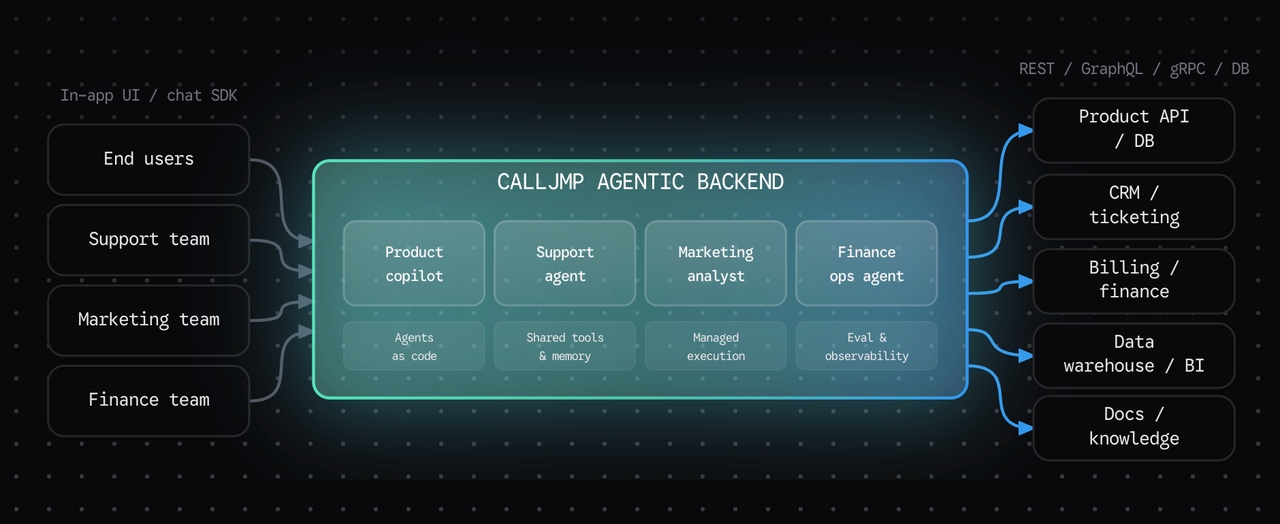
What is a backend for AI agents?
A backend for AI agents is the production layer that sits between your application, your models, and your business systems.
It gives agents the ability to run multi-step workflows, remember state, call internal APIs, access tools safely, pause for human approval, recover from failures, and expose traces for debugging and compliance.
A normal app backend handles users, data, APIs, authentication, and business logic. An AI agent backend adds the missing infrastructure agents need: durable execution, memory, tool orchestration, HITL, evals, and agent-level observability.
| Traditional backend | Backend for AI agents |
|---|---|
| Handles request/response APIs | Handles multi-step agent workflows |
| Stores product data | Stores agent state, memory, and intermediate results |
| Authenticates users | Enforces user, agent, and tool permissions |
| Calls services directly | Lets agents safely call tools and APIs |
| Logs API requests | Traces prompts, tool calls, retries, latency, and cost |
| Returns a response | Can pause, resume, retry, escalate, or ask for approval |
Why AI agents need a separate backend
A simple chatbot can send a prompt to an LLM and return an answer. Production AI agents are different. They need to run multi-step workflows, call tools, remember context, check permissions, wait for approvals, recover from failures, and create a clear record of what happened.
That is why AI agents need a separate backend layer. A backend for agents gives them the runtime, state, memory, tool access, observability, and governance required to operate safely inside real products and business systems.
Agents run longer than one API request
Most applications are built around short request-response cycles. A user clicks a button, the backend processes the request, and the system returns a result.
AI agents often do not work that way.
A production agent may need to retrieve context, call several tools, wait for an external system, ask a human for approval, retry a failed step, or resume the workflow later. Some agent workflows may run for minutes, hours, or even days.
This creates a need for an agent runtime that can manage long-running AI agents outside a single API request. The backend for agents should be able to pause and resume workflows, keep track of progress, handle retries, and make sure the agent does not lose its place when something fails.
Without this runtime layer, teams usually end up building fragile glue code around queues, cron jobs, webhooks, and custom retry logic.
Agents need state and memory
AI agents need more than a prompt and a model response. They need to know what happened before, what step they are currently on, what information has already been collected, and what should happen next.
This requires durable state.
For example, a support agent may need to remember that it already checked the knowledge base, looked up the customer account, found a billing issue, and is now waiting for approval before sending a refund request. A product copilot may need to preserve workflow state while guiding a user through a multi-step setup process.
AI agent memory is also important for keeping useful context across steps and sessions. Some memory is short-term, such as the current task. Some memory is long-term, such as user preferences, previous actions, or account-specific context.
A proper AI agent backend should separate workflow state, memory, and model context instead of forcing everything into the LLM prompt.
Agents need controlled tool access
The real value of AI agents comes when they can do more than answer questions. They need to call tools, read data, trigger workflows, and interact with business systems.
That is where a tool calling backend becomes critical.
A backend for agents should provide controlled access to internal APIs, CRM systems, billing platforms, ticketing tools, data warehouses, knowledge bases, and other business systems. The agent should not directly touch every system without limits. Instead, tools should be exposed through a controlled orchestration layer.
This tool orchestration layer defines what each tool does, what inputs are allowed, what permissions are required, and how every tool call is logged.
For example:
- a support agent may access the knowledge base, CRM, and ticketing system;
- a finance agent may access billing, invoices, and reconciliation data;
- a product copilot may call internal APIs and retrieve customer-specific product data;
- a marketing analyst agent may query a data warehouse and generate reports.
The backend becomes the tool gateway between the agent and the systems it needs to use.
Agents need permissions and audit logs
When agents can call tools, the backend becomes the control point. It decides which user, agent, workflow, and tool is allowed to do what.
This matters because an AI agent may operate on behalf of a real user. It may access private data, trigger customer-facing actions, change settings, create tickets, update records, or start workflows. Those actions need clear permission boundaries.
A production agent backend should support user-level permissions, agent-level permissions, tool-level permissions, and workflow-level rules. The agent should only access the data and actions that the current user or workflow is allowed to use.
Audit logs are equally important. Teams need to know what the agent did, which tools it called, what data it accessed, what output it generated, and whether a human approved the action.
Without permissions and audit logs, agent workflows become difficult to trust, debug, and govern.
Agents need observability and evaluations
AI agent observability is not the same as normal application logging.
With regular software, logs usually show requests, errors, latency, and database calls. With AI agents, teams also need to see prompts, model responses, tool calls, retrieved context, intermediate steps, retries, approvals, cost, and final outputs.
This is essential for debugging production agents. When an agent gives a wrong answer or takes the wrong path, the team needs to understand why. Was the prompt unclear? Was the retrieved context wrong? Did the tool return bad data? Did the model choose the wrong next step? Did a permission rule block the action?
Evaluations are also part of the backend layer. As prompts, tools, models, and workflows change, teams need a way to test whether the agent is getting better or worse. Evals help prevent regressions and give product, engineering, and operations teams a shared way to measure agent quality.
A backend for AI agents should make every run traceable, testable, and improvable.
Modernize how your company builds AI systems
Move beyond brittle workflows. Implement scalable agentic systems that adapt
Launch agentic backend →What a production agent backend should include
A production agent backend is more than a place to send prompts. It is the backend infrastructure for agents that turns AI workflows into reliable software systems.
A good AI agent backend should include several core layers: runtime, state, memory, tool orchestration, permissions, human approvals, observability, evaluations, and governance. Without these layers, agents may work in a demo but become hard to operate, debug, and trust in production.
1. Agent runtime
The AI agent runtime is the execution layer that runs agent workflows.
It should support long-running tasks, retries, timeouts, background jobs, pause and resume logic, and multi-step workflows that do not fit into a single API request.
For example, an agent may need to collect data, call several tools, wait for a human approval, retry a failed step, and continue later. The runtime keeps that workflow alive and consistent.
2. State management
Agents need to remember where they are in a workflow.
State management stores progress, decisions, intermediate outputs, tool results, errors, and pending actions. This makes it possible for an agent to continue from the right step instead of starting over every time something changes.
A production agent backend should not rely only on the LLM context window to track state. Workflow state should live in the backend.
3. Memory layer
Memory helps agents keep useful context across sessions, users, and workflows.
Some memory is short-term, such as the current task or conversation. Some memory is long-term, such as user preferences, previous actions, account context, or business-specific knowledge.
A proper AI agent backend should separate memory from workflow state and from the prompt itself. This makes agents more reliable, easier to debug, and easier to control.
4. Tool orchestration
AI agent orchestration is where the backend connects agents to real systems.
A production agent backend should let agents safely call APIs, databases, SaaS tools, internal services, knowledge bases, CRMs, ticketing systems, billing platforms, and data warehouses.
The backend should define which tools are available, what each tool can do, what inputs are allowed, what permissions are required, and how every tool call is logged.
Without tool orchestration, teams usually end up with fragile glue code between prompts, APIs, and business systems.
5. Permission layer
When agents can access tools and data, permissions become critical.
A backend for agents should control what each user, agent, workflow, and tool can access. It should enforce user-level permissions, agent-level permissions, tool-level permissions, and tenant-level boundaries.
This matters because agents often act on behalf of real users. If a user cannot access certain data or perform a certain action, the agent should not be able to do it either.
6. Human-in-the-loop approvals
Not every action should be fully automated.
A production agent backend should support human-in-the-loop approvals for risky, sensitive, or customer-facing actions. The agent should be able to pause, request approval, show context, and resume only after a human confirms the next step.
This is especially important for actions such as refunds, account changes, billing updates, data deletion, compliance decisions, or external customer communication.
7. Observability
AI agent observability shows what happened inside every agent run.
A production AI agent backend should capture prompts, model responses, retrieved context, tool calls, latency, retries, failures, approvals, cost, and final outputs.
This helps teams debug issues, understand why an agent made a decision, improve prompts and tools, and monitor agent performance over time.
Without observability, production agents become a black box.
8. Evaluations
Evaluations help teams test agent quality before and after changes.
When prompts, tools, models, workflows, or retrieval logic change, teams need to know whether the agent improved or got worse. Evals make agent behavior measurable instead of subjective.
A strong agent backend should support repeatable tests, regression checks, and quality benchmarks for important workflows.
9. Governance and audit logs
Governance gives teams control over how agents behave in production.
A backend for AI agents should create a clear record of what the agent did, which tools it called, what data it accessed, what decisions it made, and whether a human approved the action.
Audit logs are important for security, compliance, debugging, and internal trust. They also help product, engineering, support, and operations teams understand how agents are being used across the business.
In short, a production agent backend is the control layer between AI models and real business systems. It makes agents stateful, observable, permission-aware, testable, and safe enough to run inside production workflows.
Backend for agents architecture
In this architecture, the agent backend does not replace your existing systems. Your product database, CRM, billing system, and internal APIs remain the source of truth. The backend for agents provides the controlled runtime layer that lets AI agents interact with those systems safely.
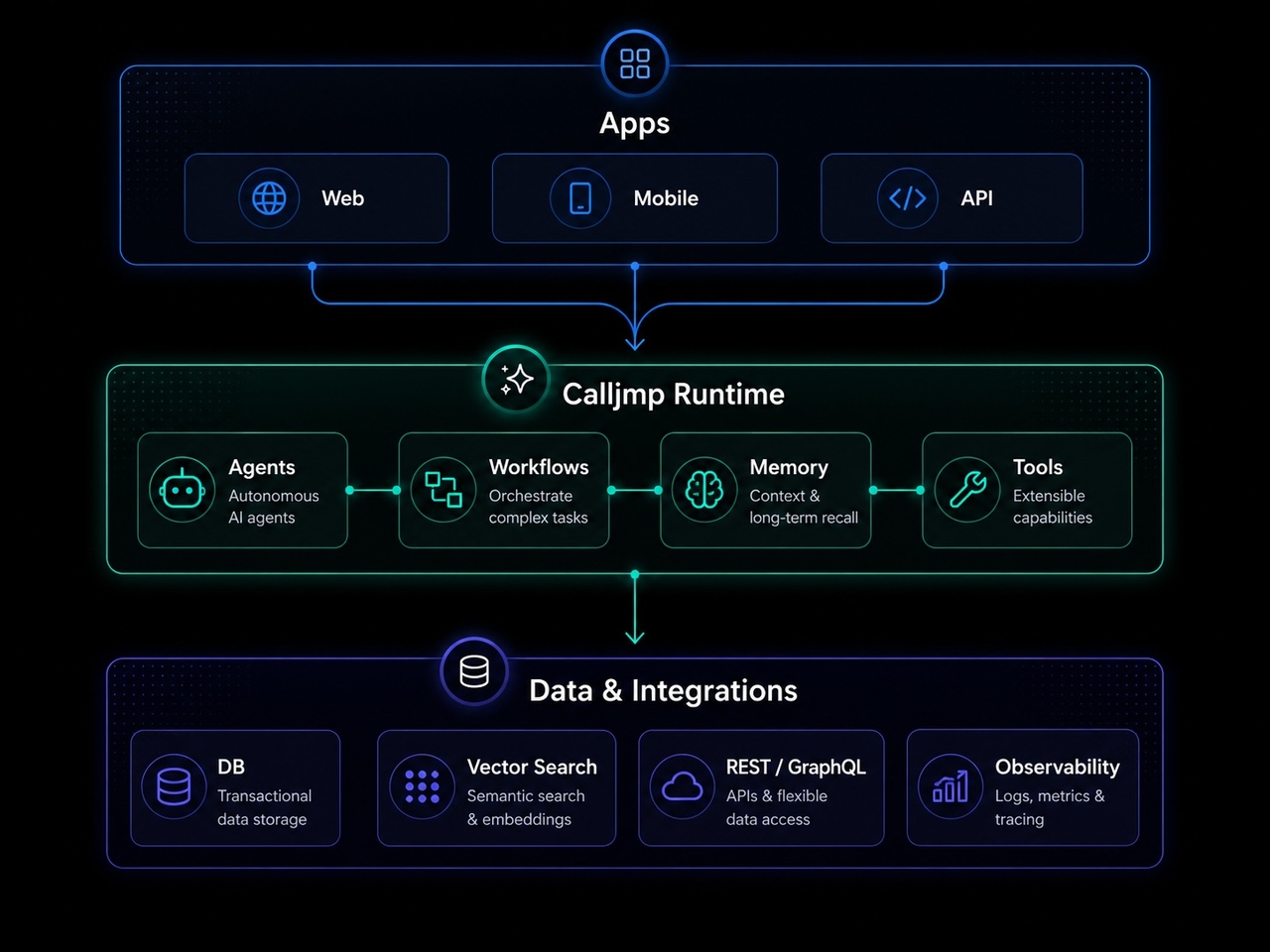
How an agentic backend integrates with existing systems
A proper agentic backend should not require rewriting your stack. It integrates using interfaces you already have:
- REST / GraphQL / gRPC to call your internal services
- DB drivers for controlled data access
- Tool adapters that wrap your systems with permission checks, validation, and audit logs
In practice, your systems remain the source of truth. The agentic backend orchestrates:
- tool calls across systems
- safe action execution
- human approvals when required
- traceability end-to-end
Build vs buy: should you build your own AI agent backend?
At some point, every team building production AI agents faces the same question: should we build our own AI agent backend, or use a managed backend for agents?
Building your own backend for AI agents can make sense if agent infrastructure is part of your core product, if you have a dedicated platform engineering team, or if you have strict deployment, security, or compliance requirements that cannot be met by an external platform.
But for most product teams, the real cost is easy to underestimate.
A production agent backend is not just a wrapper around an LLM API. To build it internally, your team needs to create and maintain the runtime, state management, memory layer, tool orchestration, permissions, human approvals, observability, evaluations, cost tracking, and audit logs.
That means building backend infrastructure for agents across multiple layers:
- long-running agent runtime;
- durable workflow state;
- memory and context management;
- tool calling and API integration;
- user, agent, and tool permissions;
- human-in-the-loop approval flows;
- retries, timeouts, and failure recovery;
- traces, logs, and cost visibility;
- evaluation workflows;
- governance and audit logs.
This is why many teams start with a simple agent prototype and later discover they are actually building AI agent backend infrastructure from scratch.
When building your own agent backend makes sense
Building your own agent backend may be the right choice if you have a large engineering team and the backend for agents is strategic infrastructure for your company.
For example, building internally can make sense when:
- your AI agents are the core product, not just a feature;
- you need full control over every part of the AI agent runtime;
- you have unusual security, compliance, or deployment requirements;
- you already have a platform team that can maintain orchestration, observability, permissions, and evals;
- you expect the backend infrastructure for agents to become a long-term internal platform.
In this case, the investment may be justified. You are not just building one agent. You are building a production agent backend that multiple teams and use cases will depend on.
When buying a backend for AI agents makes sense
Buying a backend for AI agents usually makes more sense when agents are a product feature, internal workflow, or customer-facing automation rather than the core infrastructure your company wants to own.
For example, a managed AI agent backend is usually a better fit when you want to ship:
- a product copilot;
- a support agent;
- an onboarding assistant;
- a finance operations agent;
- a sales or marketing analyst agent;
- an internal workflow automation agent;
- a customer-facing agent connected to your product data.
In these cases, your team probably wants to focus on the agent experience, product logic, tools, and business outcomes — not on rebuilding agent runtime, memory, permissions, observability, and governance from scratch.
A managed backend for agents gives your team the infrastructure layer faster, so developers can focus on writing agent workflows and connecting real systems instead of maintaining low-level orchestration code.
The hidden cost of building AI agent backend infrastructure
The hardest part of building a backend for agents is not the first prototype. The hard part comes later, when the agent needs to run reliably in production.
You need to answer questions like:
- What happens if a tool call fails halfway through a workflow?
- How does the agent resume after waiting for approval?
- Where is workflow state stored?
- How do we trace every prompt, tool call, and decision?
- How do we control what each agent is allowed to access?
- How do we test agent behavior after changing prompts, tools, or models?
- How do we track cost by customer, workflow, or agent?
- How do we create audit logs for sensitive actions?
These are not model problems. They are backend problems.
That is why the build vs buy decision for AI agents is really a backend decision. If your team builds internally, you are committing to maintain an AI agent runtime and orchestration layer over time. If you buy, you can use an existing production agent backend and spend more time on the workflows that make your product valuable.
A practical rule of thumb
Build your own AI agent backend if agent infrastructure is your company’s core technical advantage.
Use a managed backend for AI agents if your goal is to ship product copilots, support agents, internal automations, or agentic workflows faster and more safely.
For most SaaS teams, the best path is not to rebuild the entire backend for agents from scratch. It is to keep control over the agent logic, tools, and product experience while using a dedicated agent backend for runtime, state, memory, permissions, observability, evaluations, and governance.
Backend for AI agents vs agent framework
An AI agent framework and a backend for AI agents are not the same thing.
An AI agent framework helps developers define agent logic: prompts, tools, workflows, handoffs, and model calls. It is useful for building the brain of the agent.
A backend for agents is different. It is the production layer that runs agents reliably inside real products and business systems. It handles runtime, state, memory, tool orchestration, permissions, human approvals, observability, evaluations, and governance.
In simple terms: an AI agent framework helps you build the agent. An AI agent backend helps you run the agent in production.
| Category | What it does | What it does not fully solve |
|---|---|---|
| AI agent framework | Helps developers define agent logic, prompts, tools, model calls, and workflows | Production runtime, permissions, observability, memory, human approvals, and governance |
| Traditional backend | Handles users, APIs, data, authentication, and business logic | Agent-specific state, tool orchestration, evals, traces, and long-running agent execution |
| Workflow automation tool | Connects SaaS apps, triggers workflows, and automates simple business processes | Deep code-first agent runtime, product-level integration, and custom agent permissions |
| Backend for AI agents | Runs production AI agents with state, tools, permissions, HITL, observability, evals, and governance | You still need to define your product-specific agent logic, tools, and business rules |
This distinction matters because many teams start with an AI agent framework and assume they already have everything needed for production. But once the agent needs to call internal APIs, remember state, wait for approval, retry failed steps, or expose traces for debugging, the missing layer becomes clear.
That missing layer is the AI agent backend.
For example, a product copilot may use an AI agent framework to decide which tool to call. But the backend for agents should control whether that tool is available, whether the user has permission to access it, how the tool call is logged, what happens if it fails, and how the workflow resumes afterward.
The same applies to support agents, finance agents, onboarding agents, and internal automation agents. The framework defines the agent behavior. The agent runtime and backend infrastructure make that behavior safe, stateful, observable, and reliable.
That is why production AI agents usually need both:
- an AI agent framework or code layer to define the agent logic;
- a backend for AI agents to run that logic with state, tools, permissions, observability, evaluations, and governance.
A framework helps you create the agent. A backend for agents helps you operate it.
Calljmp’s role: one agentic backend for all agentic features
Calljmp is designed to be the shared backend layer for agentic AI across your company.
You define agents and workflows as TypeScript code (not a rigid visual builder), and Calljmp provides:
- managed execution for long-running workflows + HITL pause/resume
- shared tools and memory reused across multiple agents
- zero-config observability (logs, traces, retries, errors)
- evaluations to measure quality before you ship changes
- simple integration via SDK or API, connected to your existing systems
Instead of building separate bot stacks per team, you run:
- product copilot
- support agent
- marketing analyst
- finance ops agent
…on one governed runtime, with shared tooling, memory, and evaluation standards.
See your future agentic infrastructure
If your roadmap includes production agents, the question isn’t “Should we build agents?”
It’s “Where do they run, how do they integrate, and how do we govern them?”
Calljmp gives you a dedicated agentic backend that plugs into your existing stack and scales across teams.
Accelerate AI initiatives with a unified platform
A single environment for building
Explore Platform →FAQ
What is a backend for AI agents?
A backend for AI agents is the infrastructure layer that lets agents run in production. It handles runtime, state, memory, tool orchestration, permissions, human approvals, observability, evaluations, and integration with existing systems.
Do AI agents need a backend?
Yes, once they move beyond simple chat. Production AI agents need a backend to manage long-running execution, state, tools, permissions, retries, monitoring, and human approvals.
What is the difference between an AI agent backend and an AI agent framework?
An AI agent framework helps developers define agent logic. An AI agent backend runs that logic reliably in production with state, memory, permissions, tool access, observability, and governance.
What systems can an agent backend connect to?
An agent backend can connect to internal APIs, databases, CRM systems, ticketing tools, billing systems, data warehouses, knowledge bases, and SaaS applications.
What should a production agent backend include?
A production agent backend should include runtime, state management, memory, tool orchestration, permissions, human-in-the-loop approvals, observability, evaluations, cost tracking, and audit logs.
Is an agentic backend the same as a backend for AI agents?
Yes, broadly. “Agentic backend” is a category term, while “backend for AI agents” is clearer search language. Use both, but lead with “backend for AI agents.”