Best n8n Alternatives in 2026 (for Teams That Outgrew Visual Builders)
Explore n8n alternatives built for developers - see how platforms like Calljmp let you run agentic systems as TypeScript code, connected to APIs and databases.

If you’re reading this, chances are you’ve done at least one of these:
- Built a few flows in n8n, loved the power and flexibility…
- …then ended up with a spaghetti graph that nobody wants to touch.
- Started experimenting with AI steps and realized short, stateless workflows are not enough for serious agents.
n8n is a great open-source workflow tool. But as soon as you move toward agentic systems, TypeScript-defined logic, and product-grade automation, you start hitting its natural limits.
In this guide, we’ll walk through the best n8n alternatives in 2026 – from no-code automation tools like Zapier and Make, to avant-garde platforms like Calljmp, where AI becomes essential part of your core processes and tech stack; and they start growing long-term AI expertise to maintain a competitive edge.
When n8n Starts to Break Down
n8n is a strong fit when you:
- Want a self-hostable, open-source workflow engine
- Need to connect common SaaS tools and APIs
- Prefer a visual builder over writing code
But as teams scale usage, three pain points repeat.
Growing Complexity and Spaghetti Workflows
Visual builders are great for simple flows. For complex systems, they can become a liability:
- Dozens of nodes and branches on a single canvas
- Hard to review, test, and version changes
- Business logic scattered across multiple workflows with implicit dependencies
At some point, your “simple automation graph” becomes a visual programming language with no real structure.
AI Workflows and Long-Running Jobs
Most workflow engines, including n8n, are designed for:
- Short-lived executions
- Stateless task chains
- Occasional API calls to LLMs
Modern agentic systems need more:
- Planning and multi-step reasoning
- Memory (short- and long-term)
- Tool calling with branching based on context
- Long-running executions (seconds to hours) with HITL checkpoints
You can bolt some of this onto n8n, but you’re fighting the underlying model. It’s a workflow tool, not a full agent runtime.
Custom Backends, Internal Systems, and Developer Needs
As soon as you want to:
- Connect agents directly to your own API, database, auth, and storage
- Execute logic as code, not visual flows
- Ship changes with the same rigor as any other part of your backend
…you’re in developer territory. Visual workflows become hard to integrate, test, and deploy alongside normal application code.
That’s where more advanced n8n alternatives come in.
Types of n8n Alternatives
Before listing tools, it’s useful to categorize what’s out there.
| Category | Typical Tools (Examples) | Who It’s For | Main Strengths | Main Trade-offs |
|---|---|---|---|---|
| No-code / low-code automation | Zapier, Make, IFTTT, Pabbly, Integrately | Ops, marketing, non-technical users | Large catalog of SaaS integrations, fast to start | Limited depth, weak for complex logic and agentic systems |
| Open-source / self-hosted workflow engines | n8n, Activepieces, Windmill, Node-RED, Kestra | Tech teams wanting control and self-hosting | Flexibility, extensibility, self-hosting | You own infra, scaling, maintenance, and security |
| Dev-first automation platforms | Pipedream, Tray.io, Workato | Engineering teams, integration/platform groups | Strong API story, serverless style, monitoring | Focused on integrations; limited agentic AI capabilities |
| AI agent / orchestration platforms | Vellum, Dify, LangGraph, StackAI | Teams building AI-driven workflows and agents | Prompt mgmt, tool use, evals, orchestration | Often missing backend + runtime for long-running agents |
| Agents orchestration as code wired securely to your internal systems | Calljmp | Tech teams building agentic systems in TypeScript | TypeScript agents, AI runtime, RAG, memory, observability | Newer category; requires dev-first approach |
Modernize how your company builds AI systems
Move beyond brittle workflows. Implement scalable agentic systems that adapt
Learn More →Quick Comparison: n8n vs Popular Alternatives
High-level view of where n8n stands relative to other common options:
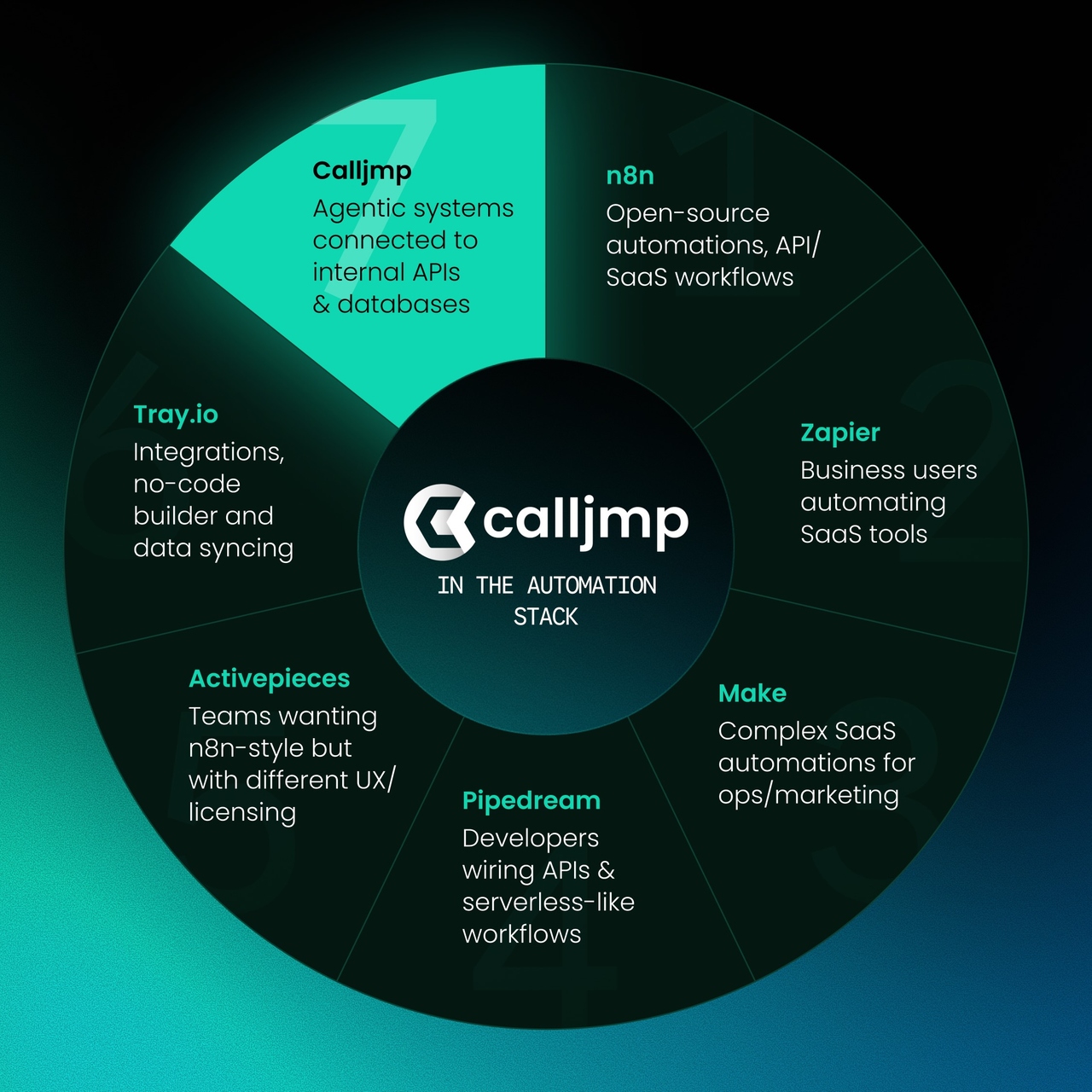
Top n8n Alternatives in 2026
1. Zapier – No-Code Automation for Business Users
Best for: non-technical users automating SaaS tools (CRM, email, marketing, support).
- Huge library of prebuilt integrations
- Very simple UI for building “Zaps” (IF this THEN that)
- Great for marketing, sales, and support teams
Where it beats n8n:
- Easier onboarding for non-developers
- More polished UX and templates
Where it falls short:
- Limited control for advanced workflows
- Not suited for agentic systems or deep AI logic
2. Make – Visual Power-User Automation
Best for: teams who need complex SaaS workflows and like visual graph-based logic.
- Powerful scenario builder with branching, mapping, aggregations
- Strong support for many SaaS tools
- Popular among ops and marketing automation teams
Where it beats n8n:
- Highly polished and expressive visual editor
- Prebuilt modules for many complex operations
Where it falls short:
- Proprietary, SaaS-only
- Not designed as an AI agent runtime or backend
3. Pipedream – Developer-Friendly Automation
Best for: teams who want to wire APIs and event sources quickly.
- Visual-first builder with possibility to use JavaScript/TypeScript to adjust agents
- Many “sources” and “destinations” (webhooks, queues, APIs)
- Strong fit for internal tools and integration glue
Where it beats n8n:
- Better developer ergonomics (code steps, npm support)
- Easier to connect modern APIs and event streams
Where it falls short:
- You write code in their interface
- No built-in backend for auth, DB, or storage
4. Activepieces – Open-Source Visual Automation
Best for: teams wanting an open-source visual automation tool similar to n8n.
- Open-source with self-hosting
- Visual flow builder with clean UX
- Accessible to both technical and non-technical teams
Where it beats n8n:
- Different UX and licensing model that may fit certain teams
- Active, growing open-source community
Where it falls short:
- Same scalability challenges of visual builders
- Limited agentic/AI-runtime capabilities
5. Enterprise iPaaS Tools (Tray.io)
Best for: enterprises orchestrating hundreds of integrations across many teams.
- Full iPaaS platforms for large organizations
- Strong governance, compliance, and RBAC
- Packaged enterprise connectors
Where they beat n8n:
- Enterprise-grade support and governance
- Mature connector ecosystem for corporate environments
Where they fall short:
- High cost and complexity
- Not optimized for AI-native or agentic systems
6. AI-Native Orchestration Platforms (Vellum)
Best for: teams orchestrating multiple models, prompts, and LLM calls.
- Prompt management and versioning
- Tool calling, evaluations, and logic orchestration
- Better visibility into LLM cost and performance
Where they beat n8n:
- Built specifically for LLM and agentic patterns
- Strong prompt/model workflows
Where they fall short:
- Often require a separate backend/runtime for execution
- Not optimized for deep application integration or long-running agents
7. Calljmp – Agents as TypeScript Code, Connected to Internal Systems
Best for: Companies looking to make AI a natural part of their system-level operations and develop internal expertise to stay ahead of competition.
Calljmp takes a different approach: instead of visual flows, you define agents and workflows as TypeScript code and connect directly to APIs, internal systems, and databases. The platform provides:
- An AI runtime for multi-step agents with planning, tools, memory, and HITL interactions
- An integrated backend (auth, DB, storage, realtime events) that’s included but optional
- Built-in observability: logs, traces, metrics, evaluations, and cost insights
- Cloudflare-native infrastructure with automatic scaling and edge performance
This makes Calljmp a strong fit for organizations looking to build reliable, maintainable, and deeply integrated agentic systems.
Integrate AI into your products and internal processes
Connect AI logic directly to your internal systems
See How It Works →High-level comparison vs n8n
| Aspect | n8n | Calljmp |
|---|---|---|
| Paradigm | Visual workflows | Agents & workflows as TypeScript code |
| Use case | MVP, simple workflows | Integration with internal systems, APIs, databases |
| Primary user | Technical users comfortable with GUI | Developers building SaaS products & internal tools |
| AI capabilities | LLM steps via nodes | Full agent runtime: planning, tools, memory, HITL |
| Runtime | Short-lived workflows | Short and long-running agents, resumable executions |
| Backend | BYO backend / external tools | Backend included (auth, DB, storage, realtime) – optional |
| Observability | Basic logs/inspection | Traces, logs, retries, metrics, evaluations |
| Deployment | Self-host or cloud | Cloud => “launch & forget” |
When Calljmp Is a Better Fit Than n8n
When Calljmp is a better fit than n8n:
- You want in-app copilots embedded directly into your web/mobile app
- You need integration with internal systems, APIs, databases
- You need agents that hold context, call tools, and evolve over time
- You prefer code-defined logic (TypeScript) with proper versioning and testing
- You don’t want to manage separate infrastructure for agents, backend, and observability
When n8n Is Still the Right Choice
Despite its limitations, n8n is still an excellent option when:
- You want a self-hosted, open-source visual automation engine
- Your workflows are mostly third-party SaaS integrations and basic API logic
- You’re not yet ready to invest in in-app copilots or deep AI agents
- Your team is comfortable with a visual environment and occasional custom nodes
If that’s your situation, you don’t need to migrate immediately. You can continue using n8n where it shines.
When You Should Move Beyond Visual Builders
It’s probably time to look beyond n8n and similar tools if:
- Your flows keep breaking as you add steps and branches
- You struggle to debug, test, and review complex workflows
- You want to ship AI features inside your product, not just automate SaaS tools
- You need long-running agents with planning, memory, and HITL review
- You want proper backend primitives (auth, DB, storage) without provisioning and wiring everything yourself
At that point, migrating to a more developer-first, AI-native platform becomes less of a nice-to-have and more of a strategic necessity.
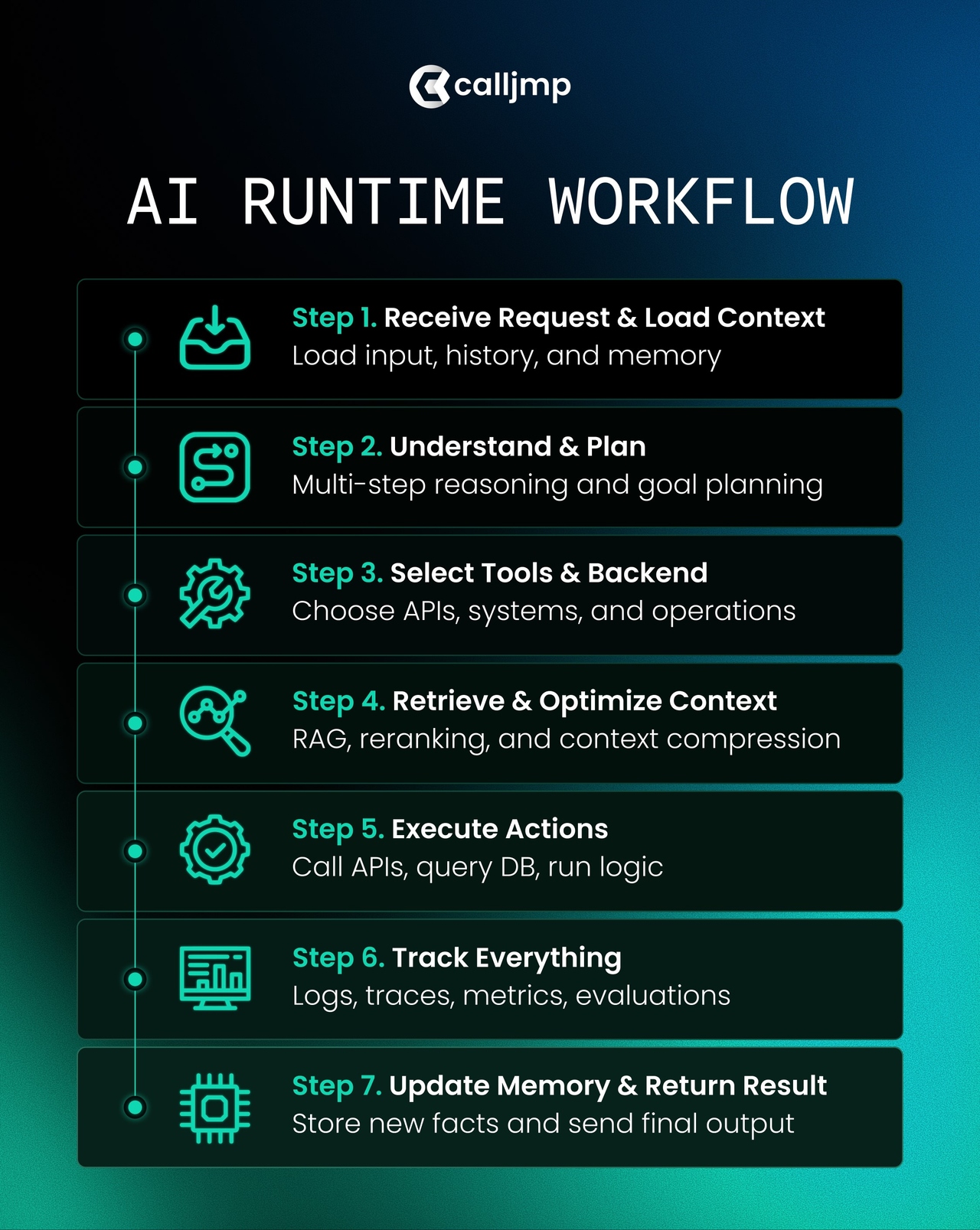
How Calljmp Fits Into Your Stack (Without Replacing Everything at Once)
You don’t have to rip out n8n tomorrow. A pragmatic path looks like this:
| Today | Transition Step | Future State |
|---|---|---|
| n8n handles general SaaS automations | Keep n8n for simple, low-risk workflows | n8n remains as an automation tool where it fits |
| New AI ideas become messy n8n graphs | Start building agents as TypeScript code in Calljmp | AI logic lives in a dedicated agent runtime |
| Backend is scattered across services | Use Calljmp’s backend where it simplifies things | Product and agents share consistent backend primitives |
| Hard to debug AI workflows | Use Calljmp’s observability and evaluations | You can trace, measure, and evolve agents continuously |
A typical pattern:
- Keep n8n (or similar) for ops automations
- Use Calljmp for product-embedded AI, internal copilots, and complex agentic workflows
Accelerate AI initiatives with a unified platform
A single environment for building
Explore Platform →Next Steps
If you’ve outgrown n8n, you have options:
- Use a no-code tool (Zapier/Make) if your main need is SaaS automation for business users.
- Use another open-source engine if self-hosting and visual workflows remain your top priority.
- Use a dev-first, AI-native platform like Calljmp if you want to treat AI agents as real software components inside your product and grow AI expertise in your business.
If you’re in that last group:
Build your first agent as TypeScript code, plug it into your app, and let the runtime handle execution, connect to your internal backend, and observability.