How to Build a Knowledge Base for Agentic AI in Payments SaaS
Learn how to build an agent-ready knowledge base for payments SaaS - core docs, agent packs, permissions, evals, and a fast 30-day rollout plan.

Agentic systems don’t fail because the model is “not smart enough.” They fail because the knowledge layer is messy: outdated docs, conflicting rules, missing edge cases, unclear ownership, and no safe boundaries for actions.
In payments (and especially orchestration), that’s dangerous. A confident-but-wrong answer can change routing, break reconciliation, or trigger support chaos. This guide shows how to build an agent-ready knowledge base (KB) for four common agents:
- AI Payments Intelligence (insights + alerts)
- AI Companion (recommend → execute with approvals)
- Support agent (tickets + troubleshooting)
- Website pre-sales agent (Q&A + qualification)
“Docs for humans” vs “knowledge for agents”
Humans skim, infer context, and notice when something looks wrong. Agents retrieve fragments and act on them.
An agent-ready KB must be:
- Trusted: sources of truth defined, conflicts resolved
- Fresh: versioned + reviewed, tied to releases
- Permissioned: public vs internal vs tenant-specific boundaries
- Structured: small “knowledge objects” with metadata
- Testable: retrieval + policy compliance evaluated regularly
Start with agent scope and risk tiers
Before collecting content, define what each agent is allowed to do.
Risk tiers (simple and effective)
- Informational (safe): answer questions with citations
- Recommendation (review): propose changes; human approves
- Execution (gated): perform actions only with approval + audit log + rollback
This single decision shapes your KB: tool-using agents need recipes, validations, and rollback—not just explanations.
Implementation note: In practice, these risk tiers are easiest to ship when your agent runs inside a workflow runtime that supports approvals (HITL), long-running runs, retries, and audit logs. Calljmp provides this as a managed runtime where agents are defined as TypeScript workflows, so you can gate actions and keep full observability by default.
Build the “Core KB” first (used by all agents)
Most teams waste time indexing everything. Start with high-signal essentials.
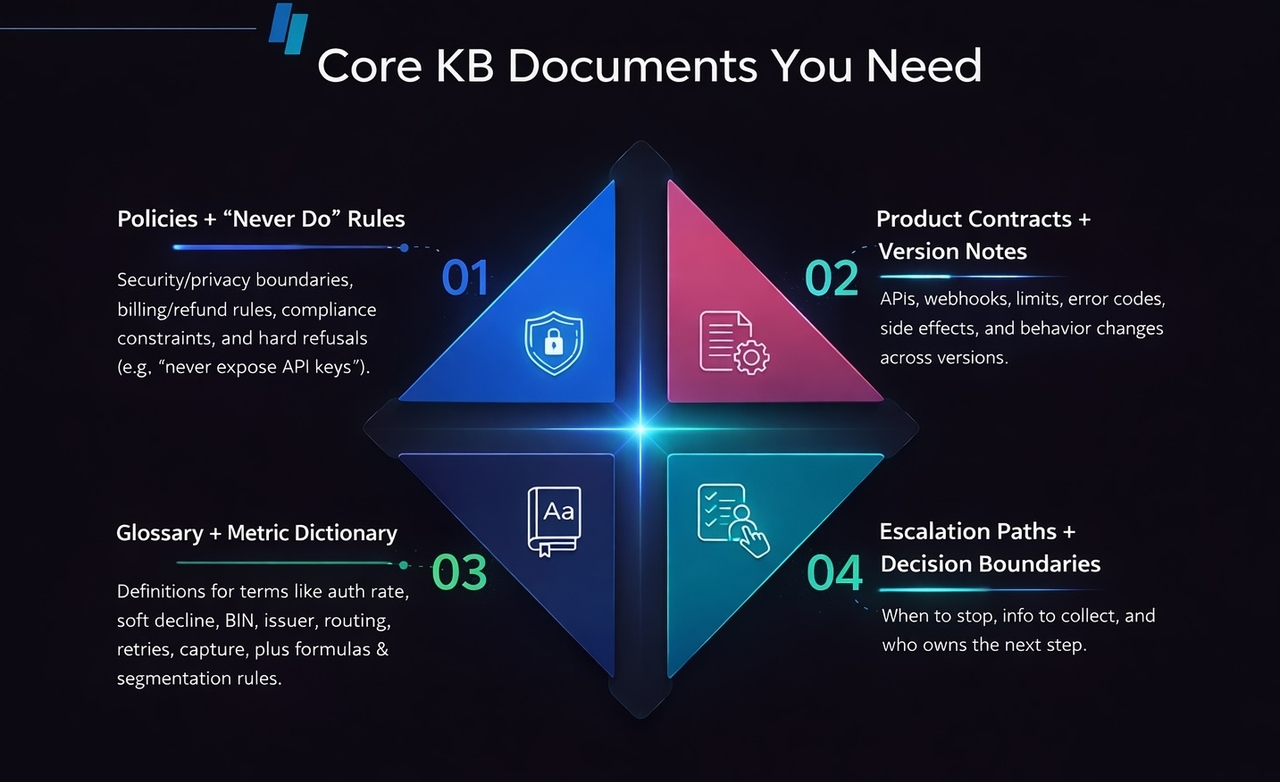
Core KB documents you need
- Policies + “never do” rules Security/privacy boundaries, billing/refund rules, compliance constraints, and hard refusals (e.g., “never expose API keys,” “never change routing without approval”).
- Product contracts + version notes What the system does in precise terms: APIs, webhooks, limits, error codes, side effects, and how behavior changed across versions.
- Glossary + metric dictionary Definitions for terms like auth rate, soft decline, BIN, issuer, routing, retries, capture, plus “how we calculate it” (formula + segmentation rules).
- Escalation paths + decision boundaries When the agent must stop, what info to collect, and who owns the next step.
If you do only this well, you already unlock safe, reliable read-only agents and a foundation for action agents.
Payments-specific KB packs (by agent)
Payments companies don’t need “one giant KB.” They need separate, purpose-built packs, because an analytics agent, an execution agent, a support agent, and a pre-sales agent each need different sources of truth, different safety boundaries, and different document shapes. In this section, we break the KB into four practical packs you can build incrementally. Each pack maps documents → agent behavior: what you store, what problem it solves, how the agent uses it in production, and what a minimal prompt looks like. The goal is to make your KB operational, so agents can reliably explain performance changes, propose optimizations with guardrails, resolve tickets faster, and answer prospects accurately without hallucinating or overpromising.
How teams implement this: Each pack becomes a set of retrieval rules + workflow steps (alerts, investigations, approvals, updates). In Calljmp, you can model these flows as TypeScript agents with built-in state, pause/resume, approvals, and traces, so the KB isn’t just referenced, it’s operationalized.
A) AI Payments Intelligence pack (insights + alerting)
This table connects the dots between what you store in the knowledge base and what the agent actually does with it in production. For each KB element, you get a concrete prompt, the task it enables, a real-life example, and the practical use case, so teams can move from “we have docs” to “we have agent-ready knowledge” without guessing.
| KB element | Example | Goal | How the agent uses it | Prompt sample |
|---|---|---|---|---|
| Metric Cards | Auth Rate (24h) = 91% in BR, down 4pp. | Detect performance dips early; produce segmented diagnosis. | Creates an alert, breaks down the drop (which PSP? which BINs?), then suggests next step: “shift affected BINs from PSP A to PSP B.” | Monitor Auth Rate by PSP/country/BIN; alert on >3pp drop; summarize causes with citations. |
| Event taxonomy | payment.failed with reason_code=05, country=BR, psp=DLocal. | Make multi-PSP data comparable and queryable for analysis. | Explains what changed using consistent fields: “Decline code 05 spiked on BR Visa BINs,” because all providers map into the same event format. | Normalize provider events to canonical schema; reject/flag events missing required fields. |
| PSP/acquirer mapping (EU) | FR debit BINs route to Barclays → MID EU_4471; fallback Worldline → MID EU_8820. | Explain routing and propose controlled optimization. | Recommends safe changes: “Move 20% of BIN range X to fallback because Barclays auth dropped,” and clarifies scope: “FR debit only, not credit.” | For a segment (e.g., FR cards), explain route + fallback; suggest safe reroute with expected impact and rollback. |
| Anomaly playbooks | Brazil auth drop: segment → confirm codes → failover 30% → validate. | Standardize incident response; reduce time-to-mitigation. | Follows the exact steps, asks for missing inputs, proposes an approved plan, and keeps ops/support consistent during incidents. | When anomaly X triggers, run playbook: gather signals, checks, propose actions, request approvals, log outcomes. |
| Fee/reconciliation rules (incl. FX) | Fee = €0.11 + 1.2% per capture; reconcile by psp_reference. | Automate recon investigation; quantify fee/FX drivers. | Explains payout gaps (“€312 difference is FX markup + rounding”), runs matching, and flags missing references when payout lines don’t reconcile. | Explain payout diffs using fee rules + FX markup; find unmatched captures by reference; draft recon report. |
B) AI Dashboard Assistant pack (recommend → execute with review)
If the agent can change routing or policies, you need action-grade knowledge:
- Action Recipes (preconditions → proposed change → expected impact)
- Experiment templates (A/B routing, ramp rules, success metrics)
- Approval rules (who must approve what)
- Validation checklists (what to verify before/after changes)
- Rollback runbooks (reversible steps, timeouts, stop conditions)
Best models:
- Strong model for planning and change proposals
- Small/fast for generating structured config snippets
- Deterministic rules/tests for validation and guardrails (don’t “LLM” your safety)
C) Support Agent pack (tickets + troubleshooting)
This is the highest-ROI pack for most SaaS teams:
- Top 30–50 troubleshooting flows (symptom → checks → fix → verify → rollback)
- Known issues (symptoms, affected versions, workaround, status)
- Comms templates (incident updates, follow-ups, root cause summaries)
- Escalation matrix (what goes to ops vs engineering vs finance)
Best models:
- Small/fast for most ticket responses with strict retrieval + citations
- Mid model for complex multi-step cases and summarizing long threads
D) Website Pre-sales agent pack (Q&A + qualification)
Goal: accurate answers without overpromising.
- Positioning + ICP (what you do, who it’s for)
- Pricing + packaging (current, unambiguous)
- Security + compliance FAQ (audited statements only)
- Comparisons (where you win/lose, honest boundaries)
- Case studies + proof points (what’s real today)
- “What we don’t do” (prevents bad-fit leads and hallucinated features)
Best models:
- Small/fast with strict retrieval + citations + refusal rules
- Avoid “creative” modes for sales-critical claims
How to structure the KB so retrieval works
Treat each document as a knowledge object, not a long wiki page.
Minimum schema (attach to every object)
type:policy | procedure | reference | templateowner:team/person accountablelast_reviewed:dateversion:product/release tagaudience:support | ops | sales | dev | publicrisk_tier:informational | recommendation | executionregion:if applicablepermissions:public/internal/tenant scopecanonical_source:URL/pathrelated:links to dependencies
Example (YAML):
id: metric_auth_rate_v3
type: reference
title: Authorization Rate (Auth Rate)
owner: Payments Ops
audience: [ops, support]
risk_tier: informational
version: "2026.03"
last_reviewed: "2026-03-01"
region: "global"
permissions: internal
canonical_source: "docs/metrics/auth-rate.md"
Where to put the KB (and how to avoid chaos)
Use a versioned source of truth + optional sync from collaboration tools.
Recommended setup (up to 500 FTE):
- Docs-as-code (Git) for policies, contracts, recipes, and playbooks (versioned, reviewable).
- Sync ingestion from Notion/Confluence/Zendesk as secondary sources (tagged, filtered, not automatically “truth”).
- Split corpora:
- Public KB (website agent)
- Internal KB (ops/support/engineering)
- Tenant KB (customer-specific contracts/configs/tickets)
If you’re running agents in production, treat the KB as versioned data with permissions and connect it through a runtime that enforces those boundaries. For example, Calljmp lets you keep your source of truth in Git/Notion/Zendesk, then apply tenant isolation, role-based retrieval, and citations at run time along with logging/traces for every retrieval and action.
Evaluation and maintenance loop (the part most teams skip)
- Build a golden set from real tickets/incidents (plus edge cases).
- Test two things separately:
- Retrieval correctness (did we fetch the right source?)
- Policy compliance (did we follow rules and cite properly?)
- Tie KB updates to releases: ship feature → update KB → tests pass → deploy agent
Set lightweight “KB SLOs”:
- freshness (review cadence)
- coverage (top flows documented)
- time-to-fix for wrong answers
A practical 30-day rollout plan
Here’s a high level plan to execute this without turning “KB work” into a months-long documentation project. The plan below is designed for teams up to ~500 FTE: you start with a small, high-signal Core KB, ship a read-only agent quickly, then layer in observability, alerts, and finally gated actions with approvals and rollback. Each week produces something usable in production, not just more documents.
Week 1: Define agents + risk tiers; build Core KB (policies, contracts, glossary). Week 2: Create 30–50 support flows + escalation matrix; launch support agent read-only. Week 3: Add intelligence pack (metric cards, taxonomy, anomaly playbooks); ship alerts with citations. Week 4: Add companion pack (action recipes + approvals + rollback); enable “recommendation tier” first, then gated execution.
Closing: what “good” looks like
At up to 500 FTE, you don’t need enterprise bureaucracy. You need:
- a small, high-signal Core KB,
- agent-specific packs,
- clear ownership and versioning,
- permission boundaries,
- and ongoing tests.
That’s how you get agents that are actually reliable in payments: grounded, safe, and useful, without turning your team into full-time document wranglers.
A strong knowledge base isn’t a side project. It’s a core milestone in any AI implementation roadmap. Before you add more models, tools, or “agent features,” you need a trusted source of truth that’s versioned, permissioned, and testable, so the system can retrieve the right context and act safely. Build the Core KB first, then add agent-specific packs, evaluations, and approval gates as you expand scope. Done this way, your AI rollout stays incremental and controlled: you ship useful capabilities early, reduce risk as agents become more powerful, and keep reliability high as the company scales.
1) Q: Why can’t we just dump all docs into a vector database and use RAG?
A: Because payments knowledge is full of conflicts, drift, and edge cases. Dumping everything increases noise and makes the agent “average” across contradictory sources. An agent-ready KB starts with a curated Core KB (policies, contracts, glossary, escalation rules), adds purpose-built packs per agent, and enforces precedence + citations so answers stay reliable.
2) Q: What’s the minimum KB we need to ship a useful agent?
A: Start with the Core KB: (1) policies/never-do rules, (2) product contracts + version notes, (3) metric & term glossary, (4) escalation boundaries. Then add one pack based on your first agent: support flows (fast ROI) or metric cards + playbooks (ops intelligence). You don’t need “everything”, you need “high-signal.”
3) Q: How do we prevent the agent from leaking customer data or internal incident info?
A: Split the KB into separate corpora: public, internal, and tenant-specific. Apply role-based retrieval filters before semantic search, and require citations that point to the correct corpus. For any execution-tier action, add approvals + audit logs. The agent should never “browse” across boundaries by default.
4) Q: Who owns and maintains the KB in a company up to 500 FTE?
A: Make it federated: each domain team owns its slice (payments ops owns metrics/playbooks, engineering owns contracts, finance owns fees/recon, support owns flows), and one editor/ops lead enforces format and review cadence. Tie updates to releases and incident retros so KB freshness becomes part of shipping, not a side project.
5) Q: What model should we use for each agent type?
A: Keep it pragmatic: use a small/fast model for routine support answers and pre-sales Q&A (with strict retrieval + citations). Use a mid model for longer case summaries and explanations. Use a strong model for planning, RCA narratives, and change proposals—then gate execution with approvals and deterministic validations (don’t rely on the LLM for safety checks).