LLM Optimization for Production AI Agents: Cut Costs Without Cutting Quality
Most AI agent teams overpay for inference by routing every task through frontier models. Here's how to cut LLM costs by 90%+ without sacrificing output quality.

A message comes in at 2pm: "We need to replace grok 4.1 for fast reasoning. It retires tomorrow"
Not next quarter. Tomorrow.
That's a production emergency created by a single architecture decision: call a model directly in code, ship it, move on. It works until the provider retires it overnight. Then a routine afternoon becomes an incident.
LLM cost optimization has the same root cause. Most agent teams default to GPT-4o or Claude for every task — classification, extraction, summarization, reasoning — not because those models are optimal for each job, but because they're the path of least resistance. The inference bill scales linearly with usage. The architecture stays one deprecation notice away from breaking. And any serious LLM cost comparison gets dismissed as a future project, because actually swapping models means touching agent code.
Both problems share a root cause: model selection treated as a code decision rather than a configuration decision.
This article covers how to fix it — how to match models to tasks, which cheap LLM APIs hold up in production, and how to build agent systems where swapping a model is a config change, not an incident.
Why LLM Cost Optimization Matters for Production AI Agents
Most teams don't choose a model architecture. They fall into one.
The pattern is consistent: build a prototype with GPT-4o because it's capable and well-documented, hit the first milestone, ship to production. The model that worked in development becomes the model that runs everything — not because anyone evaluated it at scale, but because switching feels like a risk when something is already working.
At low volume, inference costs are invisible. 10,000 actions per month with medium-complexity tasks on GPT-5 comes to roughly $69 in inference. Manageable. But agent usage compounds fast: the same setup at 100,000 actions is $875 per month, and at 500,000 actions it's $4,375 — before retries, memory calls, or the output token bill, which on GPT-5 runs at $10/M, four times the input rate.
The second problem is that costs stay invisible until they hit the monthly invoice. Most teams have no per-step visibility in production — no breakdown by agent, workflow, or task type. Without that granularity, LLM cost optimization is guesswork. You can't reduce what you can't measure. Per-step cost and token tracking converts this from a finance problem into an engineering one: visible, attributable, and improvable.
The deprecation trap closes the loop. When model selection is a code dependency — an API string hardcoded at the call site — every model change requires an engineering cycle. Teams stay on expensive models longer than they should, not because they can't find a cheaper alternative, but because the switching cost feels higher than the model cost. That calculus gets worse as usage grows.
These three forces — default model selection, cost invisibility, and switching friction — are why most AI agent teams overpay for inference. None of them are budget problems. All of them are architecture problems.
Frontier vs. Open-Source: An LLM Cost Comparison for Agent Tasks
The case for defaulting to a frontier model was strongest 18 months ago, when the quality gap was wide enough that nothing else competed at production scale. That argument has weakened sharply.
On coding benchmarks, the gap is essentially closed — MiniMax M2.5 scores 80.2% on SWE-bench Verified against Claude Opus 4.6 at 80.8%. On general reasoning, top open-source models sit within 3–5 percentage points of GPT-5 and Claude Sonnet on MMLU-Pro. The customer conversation that opened this article captures the practical version of the same finding: a developer comparing GLM against Opus for agent work and concluding GLM matched Opus on his use case. That's not a one-off opinion — it's now the median experience for non-frontier agent tasks.
Frontier models still earn their price in a specific set of cases: long-horizon reasoning with high failure cost, complex multi-step code generation, nuanced creative work, and edge cases requiring broad world knowledge. Real, but narrow.
For everything else — extraction, classification, summarization, structured output generation, routing decisions, memory operations — an honest LLM cost comparison gets brutal fast. At 10,000 medium-complexity actions per month:
- GPT-5.5 (frontier flagship): $225.00
- GPT-5 (mainstream baseline): $68.75
- Llama 3.3 70B (Cloudflare Workers AI): $15.66
- Qwen3-30B-A3B: $2.44
- Granite 4.0 Micro: $0.82
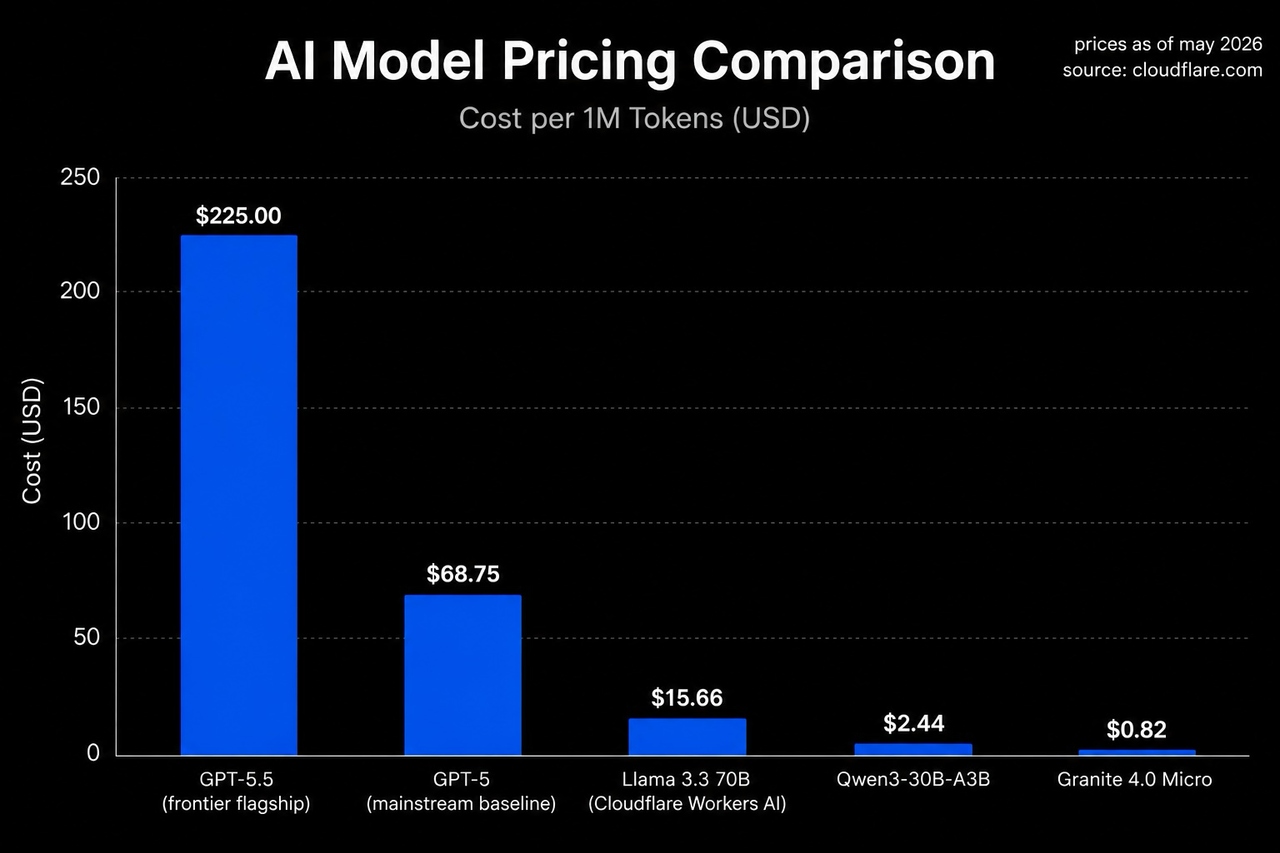
Scale those to 100,000 or 500,000 actions and the gap stops being a procurement detail. It becomes a strategic constraint — a frontier-only architecture prices certain product features out of reach entirely, because the unit economics never work. An LLM API cost comparison done honestly at production scale almost always points to a mixed-model strategy, not a single-vendor one.
The question isn't whether open-source models are good enough. The question is whether you've matched them to the tasks where they're good enough — and that's a routing problem, not a model selection problem.
Stop building AI agents around a single model
Route each agent task to the right model — frontier where it matters
Launch agentic backend →Model Routing: The Core of LLM Optimization
The architecture pattern that follows is model routing — choosing which model handles which task based on what the task actually requires, not what the team happened to use in the prototype.
Most agent workflows decompose into a small number of recognizable task types:
- Classification and routing — labeling, intent detection, conditional branching. Output is a handful of tokens. Reasoning required is minimal.
- Extraction — pulling structured fields from unstructured input. Needs instruction-following discipline; doesn't need world knowledge.
- Summarization and Q&A — condensing context, answering grounded questions. Needs language fluency; tolerates a wide range of model sizes.
- Reasoning and planning — multi-step problem solving, code generation, agentic loops. This is where frontier capability earns its price.
Once these are named, the model decision becomes obvious for each step. A classification step doesn't need GPT-5; it needs the cheapest model that returns a reliable label. An extraction step doesn't need Claude Opus; it needs a model that follows a JSON schema without hallucinating fields. A reasoning step that decides whether to escalate to a human might justify the most capable model available — but that step runs once per workflow, not on every action.
Running everything through GPT-5 or Claude Opus isn't a quality decision. It's the absence of a routing decision. The cost of that absence scales linearly with usage.
The technical pattern is straightforward: the agent runtime treats model selection as a parameter, not a hardcoded dependency. Each step in the workflow names the model it should run on, defined in configuration rather than in code. Agent logic stays stable. The model strategy becomes a tunable surface — A/B testable, observable, and swappable when something better or cheaper comes along.
This is the foundation of every serious LLM cost optimization strategy at production scale: not "find the cheapest model that works," but "build the abstraction that lets you route to the cheapest model that works for each step." The first version might be a switch statement. The mature version is part of your runtime.
Use the LLM Cost Calculator to See Your Real Numbers
The numbers throughout this article use a standard scenario: 10,000 medium-complexity actions per month. Your actual workload differs — in action volume, token count per step, and task mix across your workflows. Use the LLM cost calculator below to input your own usage and see the exact monthly cost across every model covered in this article, from Granite Micro at $0.017/M to GPT-5.5 Pro at $30/M.
Run the numbers for your workload →
Cheap LLM APIs That Actually Hold Up in Production
The phrase "cheap LLM API" is misleading unless you define "cheap" correctly. What matters in production isn't cost per token — it's cost per successful output. A model priced at $0.05/M input isn't cheap if 30% of its responses fail validation and get retried. You pay for the failed call, the retry, and the engineering time spent chasing non-deterministic output errors.
That's where most cheap LLM API comparisons fall apart. They rank models by sticker price without measuring whether the model holds up under real conditions: strict JSON schemas, long-context retrieval, multi-turn workflows, function calling with edge cases. A model that's 10× cheaper but fails 4× more often costs more in practice, not less.
The Cloudflare Workers AI catalog has converged on a tier of models that pass the production bar for specific task types:
- Granite 4.0 Micro ($0.017/M input) — classification, intent detection, routing. Output is a short label. Reliable instruction-following at this scope.
- Llama 3.1 8B ($0.045/M input) — extraction and structured output with moderate complexity. Good JSON discipline.
- Qwen3-30B-A3B ($0.051/M input) — multilingual tasks, longer-context extraction, lightweight summarization. The most capable cheap LLM API option for generalist work.
- GLM-4.7 Flash ($0.060/M input) — strong on Chinese and multilingual workloads, tool calling at low cost.
- Llama 3.3 70B ($0.293/M input) — when you need a real generalist and want to stay below direct-API frontier pricing. Holds up on most reasoning-light agent steps.
Where these models predictably fail: complex multi-step reasoning, production-quality code generation, long-context retrieval where the answer is buried, prompts that demand strong world knowledge. Sending those tasks to a $0.017/M model is the mirror image of sending classification to GPT-5 — wrong tool, predictable failure.
Capturing the savings depends on something that's easy to forget: per-step cost and quality observability, retries with model fallback, and the ability to compare model outputs side-by-side on real workload samples — without rewriting your agent code. Without that infrastructure, the cheap tier stays theoretical.
Model Lock-In Is an Infrastructure Problem
The cheap tier of models only delivers savings if your infrastructure can use it. Without per-step observability, retries, and frictionless model swapping, the optimization opportunity stays trapped behind engineering work that never gets prioritized.
That's the deeper issue with most agent stacks: model selection is treated as code, not configuration. The default pattern is to import a model SDK and write something like openai.chat.completions.create({ model: "gpt-5", ... }) at every call site. Once that pattern is in your codebase, swapping models means touching every step that calls the old one. Multiply by every workflow and you've accumulated model lock-in — not by choice, but by the path of least resistance.
A model-agnostic architecture inverts the default. Each workflow step declares which model it runs on. The runtime resolves the call. Observability captures cost and quality per step. You can A/B test models without redeploying. You can fall back to a cheaper model when the expensive one rate-limits. You can swap a deprecated model with a config change instead of an engineering sprint.
This is the architecture Calljmp implements as a managed agentic backend. Agents are TypeScript code. Model selection is configuration. Every model in this article — frontier and open-source — runs through the same execution interface on Cloudflare Workers AI. Per-step cost and quality are tracked by default. When a model gets deprecated, the migration is a config change, not an incident.
Which brings the article full circle. The message that opened this piece — "I'm looking for a replacement for grok 4.1 fast reasoning — it retires tomorrow" — describes a real emergency on the wrong infrastructure. On the right infrastructure, it's a routine routing update with rollback in place and observability watching.
LLM cost optimization isn't a project you finish. It's a property of how your agent runtime is built. Once the abstraction is right, optimization becomes continuous — a function of routing decisions, not engineering cycles. That's what model-agnostic infrastructure makes possible: an architecture where switching models is cheaper than staying on the wrong one.
Build AI agents that survive every model deprecation
Every model — frontier and open-source — through one TypeScript interface on Cloudflare Workers AI. Route by task
Try Calljmp free →FAQ
What is LLM cost optimization for AI agents?
LLM cost optimization for AI agents is the practice of matching each agent task to the cheapest model capable of completing it reliably — instead of routing every step through the same frontier model. Classification, extraction, summarization, and reasoning have very different model requirements. Running them all through GPT-4o or Claude Opus is the most expensive option by default; routing them to task-appropriate models typically reduces inference costs by 80–95% without quality loss.
What's the difference between model selection and model routing?
Model selection is choosing one model for your entire system. Model routing is choosing different models for different steps within a single workflow. Selection treats the model as a hardcoded dependency; routing treats it as configuration. A routed architecture sends classification to a $0.017/M model and reasoning to a $3/M model in the same agent run, without touching agent code.
How much can model routing actually save?
At 10,000 medium-complexity actions per month, running everything through GPT-5 costs about $69 in inference. A routed architecture that uses Granite Micro for classification, Qwen3-30B for extraction, and Llama 3.3 70B for reasoning typically costs $5–$15 for the same workload. Savings scale roughly linearly with usage — the higher your volume, the more the routing investment pays off.
Which LLM is best for production AI agents in 2026?
There is no single best LLM for production agents. The right answer depends on the task: Granite 4.0 Micro and Llama 3.2 1B for classification, Qwen3-30B-A3B and GLM-4.7 Flash for extraction, Llama 3.3 70B for general reasoning, and Claude Opus 4.7 or GPT-5.5 for the hardest multi-step planning. Production architectures usually combine three to five models routed by task type.
Can I switch from GPT-5 to an open-source model without rewriting code?
Only if your agent runtime treats model selection as configuration rather than code. If your agents call the OpenAI SDK directly with hardcoded model strings, switching providers requires touching every call site. A model-agnostic backend resolves the model at runtime based on config — making provider migration a config change rather than an engineering project.
What is the cheapest reliable LLM API for production AI agents?
For classification, intent detection, and routing, Granite 4.0 Micro on Calljmp hosted on Cloudflare Workers AI at $0.017/M input tokens is currently the lowest-cost reliable option. For extraction and structured output, Qwen3-30B-A3B and GLM-4.7 Flash hold up at production scale. The cheapest API only delivers savings if it returns valid output — measure cost per successful response, not cost per token.