AI Agent Infrastructure in 2026: The Honest Build vs Buy Decision
Gartner says 40% of agentic AI projects will fail by 2027. Here's the honest build vs buy math for AI agent infrastructure in 2026.

AI agent infrastructure is the execution layer that runs AI agents and multi-step agentic workflows in production: long-running runtime, stateful pauses, human-in-the-loop (HITL) approvals, memory, RAG, observability, evals, and cost tracking. In 2026, the question for CTOs and technical founders is no longer whether you need this layer — it's whether you build it yourself or buy a managed platform. Gartner predicts over 40% of agentic AI projects will be canceled by the end of 2027, primarily due to escalating costs and unclear business value. Both are downstream of the infrastructure decision. This article walks through the real math.
What is AI agent infrastructure, really?
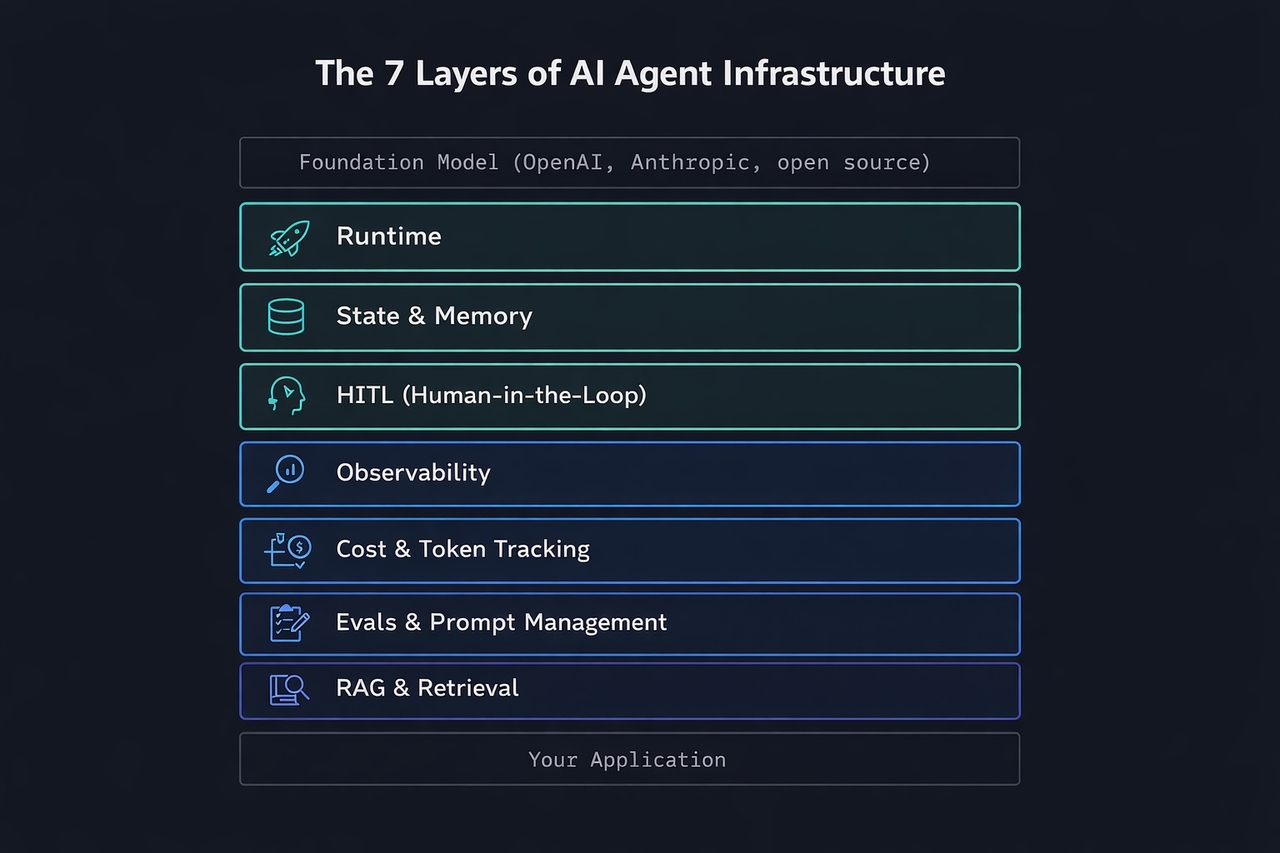
AI agent infrastructure is the production runtime and supporting systems required to run LLM-driven agents reliably at scale. It sits between the foundation model (OpenAI, Anthropic, Google, open source) and your product. It is not the model. It is not the orchestration framework. It is the layer that turns a working prototype into something you can run in production, whether you're shipping an AI feature to customers or automating internal operations.
A complete AI agent infrastructure stack includes seven functional layers:
| Layer | What it does |
|---|---|
| Runtime | Executes multi-step agent workflows, including long-running jobs that can take minutes, hours, or days. |
| State & memory | Persists context across runs without overflowing the model's context window. |
| HITL (human-in-the-loop) | Pauses execution for approvals, escalations, or manual input. |
| Observability | Traces, logs, replay, failure inspection, prompt versioning. |
| Cost & token tracking | Per-run, per-user, per-tenant spend with alerts and budgets. |
| Evals & prompt management | Systematic testing of prompt and model changes before deployment. |
| RAG & retrieval | Connects agents to structured and unstructured data reliably. |
A reasonable rule of thumb: the foundation model does roughly 10% of the work. The infrastructure around it does the other 90%. That ratio is why the "build a wrapper around GPT" thesis didn't survive contact with production.
Why 40% of agentic AI projects will be canceled by 2027
Infrastructure is the bottleneck. Not the models.
In June 2025, Gartner published a prediction that has since been cited in nearly every enterprise AI post-mortem: over 40% of agentic AI projects will be canceled by the end of 2027, due to escalating costs, unclear business value, or inadequate risk controls. The root cause isn't model capability. It's what happens around the model.
Three failure modes dominate:
1. Escalating costs teams didn't forecast. Surprise costs rarely come from the model provider invoice. They come from high-frequency API calls at scale, custom connectors to legacy systems, and ongoing operational costs for agent monitoring and incident response. An agent that costs pennies in development can cost hundreds of dollars per user per month in production once it's running 24/7 across real workflows.
2. Unclear business value that infrastructure can't make visible. Without per-agent, per-user, per-feature cost attribution, finance teams can't tie spend to outcomes. Without observability, engineering teams can't debug why a workflow failed. Both create the same result: nobody can prove the project is worth continuing.
3. Inadequate risk controls, especially around HITL and governance. Production agents take actions against real systems and real data. Without approval flows, permission boundaries, and audit trails, one misfire can create a compliance incident. In regulated industries, this alone kills projects.
Gartner also notes a supply-side problem: only about 130 of thousands of agentic AI vendors are real. The rest are practicing what the analyst community now calls "agent washing" — rebranding existing chatbots and RPA tools with agentic language. This matters when you're evaluating vendors. The market signal is noisy by design.
What production AI agent teams actually spend their time on
If you want to understand where agentic AI infrastructure spend goes, look at what production teams say is breaking.
Cleanlab's AI Agents in Production 2025 report surveyed 1,837 engineering leaders. Only 95 reported having AI agents live in production. That is roughly 5%, confirming what MIT's State of AI in Business 2025 reported earlier that year. Within that narrow slice, the patterns are consistent and useful.
Stack churn is constant. 70% of regulated enterprises rebuild their AI agent stack every three months or faster. One respondent described moving from LangChain to Azure in two months, then considering moving back again. This is the tax you pay for building on a DIY foundation: every framework change, every model deprecation, every new capability forces another rebuild.
Reliability is the weakest layer. Fewer than one in three teams are satisfied with observability and guardrail solutions, making reliability the weakest link in the stack. Observability is the #1 planned investment area going into 2026.
Most teams are still early in capability. Only 5% of engineering leaders cite accurate tool calling as a top challenge, showing how little of enterprise AI is yet focused on deeper reasoning or operational reliability. Translation: most production agents are still wrestling with basics — response quality, uptime, cost — not sophisticated multi-agent coordination.
Governance is a hard requirement, not a nice-to-have. 42% of regulated enterprises plan to add oversight features such as approvals and review controls, compared to only 16% of unregulated enterprises. HITL is becoming table stakes for anything customer-facing in finance, healthcare, legal, and compliance-heavy B2B.
The common thread: the problems teams are solving are infrastructure problems, not model problems.
See what to build vs buy
Share your agent use case and current stack. We’ll help you map which parts of your AI agent infrastructure should stay in-house and which can be handled by a managed runtime.
Talk to an expert →The real build vs buy math for AI agent backend infrastructure
Build vs buy is usually framed as a cost comparison. That's the wrong frame. The right frame is time-to-revenue and opportunity cost.
Here's the honest accounting for building AI agent backend infrastructure in-house:
What you're actually committing to build
At minimum, production-grade infrastructure for AI agents requires:
- A durable workflow engine that survives crashes mid-run
- State serialization that handles arbitrary pause/resume points
- HITL primitives with secure external approval surfaces
- A memory layer that doesn't overflow context windows on long runs
- Trace capture with prompt-level replay
- Token and dollar cost attribution per run, user, and feature
- A prompt and eval system that plugs into CI
- Rate limiting, retry logic, and backoff for model provider failures
- Multi-tenant isolation if you serve more than one customer
- SOC 2-aligned audit logging
A senior engineering team that has done this before can deliver a first version in 3–6 months. A team doing it for the first time typically takes 9–18 months to reach something genuinely production-grade. Either way, you're spending engineering cycles on infrastructure your customers will never see.
The cost of DIY, honestly calculated
Take two senior backend engineers at a fully-loaded cost of $250K/year each. A 9-month build equals roughly $375K in direct engineering cost. Add 20–30% for infrastructure bills, third-party observability tools (Datadog, Langfuse, Arize), and evaluation tooling. Call it $475K–$500K to ship v1.
That is the cheap part.
The expensive part is what you don't ship while you're building infrastructure: the agent-powered features your product team is waiting on, the customer integrations your sales team is holding, the competitive moves you can't respond to. Cleanlab's data shows that teams that build in-house rebuild every three months. The $500K initial spend is a recurring line item, not a one-time cost.
PagerDuty data cited in recent enterprise analyses suggests early adopters who get the architecture right report an average of 171% ROI, rising to 192% in the US. That figure reflects the median successful deployment, not the average attempt. The gap between those two is where the 40% cancellation rate lives.
When building makes sense
Build your own AI agent infrastructure when at least two of the following are true:
- You have deep, specific requirements no vendor can meet (air-gapped deployment, custom hardware, proprietary protocols).
- You have a dedicated platform team of 4+ engineers whose job is infrastructure, not product.
- Your agentic AI is your core product, not a feature inside a broader product.
- You have a clear 18–24 month runway to iterate without commercial pressure.
When buying makes sense
Buy a managed infrastructure platform for AI agents when any of these are true:
- You're a SaaS team adding AI agent features to an existing product.
- You're a technical founder trying to ship an AI-native product before a funded competitor.
- You're a mid-size engineering team (5–50 engineers) where infrastructure is a cost center, not a differentiator.
- You need HITL, observability, and cost tracking on day one, not in month nine.
- You're operating under TypeScript or Node.js and want your agents in the same language as your product.
For most companies in the 1–200 FTE range, the answer is buy. Not because building is impossible, but because the time cost of building is almost always higher than the license cost of buying — and the real competitor for most teams isn't LangChain or a framework. It's the 18 months of product work that didn't happen because the team built infrastructure instead.
How to evaluate AI agents infrastructure vendors (and spot agent washing)
With Gartner noting only around 130 genuine agentic AI vendors, evaluation is as much about filtering as comparing. Use this checklist when vetting any platform claiming to be AI agent infrastructure:
- Can it run a 30-minute workflow reliably? Long-running execution is the bar. If the vendor's examples are all sub-10-second chatbot calls, it's not built for agent workloads.
- Does it handle state without relying on the LLM's context window? Context window overflow is the real failure mode for long agentic runs — not "LLMs have no memory," which is a common misframing. Persistent state must live outside the model call.
- Is HITL a first-class primitive, not a code example? Approvals and escalations need to be an API, not a pattern you stitch together.
- Does observability include cost attribution? Traces without dollar-per-run data won't survive a finance review.
- Is there a real eval and prompt management system? Shipping prompt changes without regression testing is the fastest way to break production.
- How does it handle multi-tenancy? If you serve multiple customers, data isolation can't be a DIY problem.
- What's the exit path? Data portability, open standards, and the ability to export your agent definitions matter more than any feature.
- What language does it run in? Python-first platforms force context switching if your product is TypeScript. TypeScript-native platforms reduce that friction to zero.
If the vendor can't give clear answers to all eight, keep looking.
A note on categories
These are not all the same product:
- Frameworks (LangChain, Mastra, LangGraph, Vercel AI SDK): You still host, scale, and debug.
- Visual builders (n8n, some Zapier-style tools): Great for simple flows, poor for complex logic and version control.
- Orchestration platforms (Inngest, Trigger.dev): Solve durable execution, but not AI-specific concerns like evals or HITL for agents.
- Managed agentic backends (Calljmp and a small number of peers): Bring runtime, state, HITL, observability, memory, and cost tracking together as one managed layer.
The category that maps to "AI agent backend infrastructure" in the sense most teams actually need is the last one. The other categories solve parts of the problem, and if you pick them, plan for the integration work.
Launch agents without building the runtime
Use Calljmp’s out-of-the-box agentic infrastructure to run long workflows
Talk to an expert →Where Calljmp fits
Calljmp is a managed agentic backend for TypeScript teams. You write your agents and workflows in TypeScript. The runtime — long-running execution, stateful pauses, HITL, observability, memory, RAG, evals, cost tracking — is already built. It deploys on Cloudflare's edge, which removes the "where do I host this" conversation. Most of the 95 lines of TypeScript demo customers cite replace what would otherwise be several hundred lines of custom infrastructure plus a Kubernetes cluster.
It's one option among several. The relevant question isn't whether Calljmp is the right choice — it's whether the time you'd spend building the equivalent is worth more than the time you'd spend shipping product on top of it.
Key takeaways
- AI agent infrastructure is the execution layer — runtime, state, HITL, observability, memory, evals, and cost tracking — not the model, not the framework.
- Gartner predicts over 40% of agentic AI projects will be canceled by end of 2027, driven by infrastructure-related failures: costs, value visibility, and risk controls.
- Only ~5% of surveyed companies have agents live in production, and even those teams rebuild their stack every three months on average.
- Observability and reliability are the weakest layers across production deployments — and the #1 planned investment area for 2026.
- Build vs buy is a time-to-revenue decision, not a cost decision. Building consumes 9–18 months of senior engineering time that's not building product.
- Agent washing is real. Gartner estimates only about 130 of thousands of agentic AI vendors are genuinely agentic. Evaluate with a checklist, not a demo.
- TypeScript-native infrastructure matters if your product is TypeScript. Language fragmentation adds hidden cost.
Ready to stop building agent infrastructure from scratch?
Calljmp gives you out-of-the-box AI agent infrastructure
Get startedFAQ
What is AI agent infrastructure?
AI agent infrastructure is the production runtime layer that executes AI agents and agentic workflows reliably. It includes long-running execution, state management, human-in-the-loop approvals, observability, memory, RAG, evals, and cost tracking. It sits between the foundation model and your application and handles everything that isn't the model call itself.
Do I still need AI agent infrastructure if I'm calling the OpenAI or Anthropic API directly?
Yes, for anything beyond a prototype. Direct API calls give you a model. They don't give you durable execution, state across steps, failure recovery, HITL, cost attribution, or observability. You will build these yourself, or buy them. Production AI agents need all of them.
What's the difference between LangChain and a managed AI agent backend?
LangChain is an orchestration framework — a library you install. You still host, scale, monitor, and debug it. A managed AI agent backend, like Calljmp, is the runtime itself: you write agent logic and the platform handles execution, state, HITL, and observability. Framework vs managed service is the distinction.
How much does it cost to build AI agent infrastructure in-house?
A realistic in-house build costs $400K–$600K in engineering time for a first version, over 9–18 months with two senior engineers. The larger cost is opportunity cost: product features not shipped while the team is building infrastructure. Ongoing maintenance and rebuilds add roughly 20–30% per year.
Is agentic AI infrastructure the same as workflow orchestration?
Partially. Workflow orchestration platforms like Inngest and Trigger.dev solve durable execution, which is one layer of agentic AI infrastructure. They don't solve AI-specific concerns: evals, prompt management, HITL designed for agent approvals, token-level cost tracking, or agent memory. A full agentic backend covers both.
When should a startup buy rather than build AI agent infrastructure?
Buy when AI agents are a feature of your product rather than the product itself, when you have a small engineering team (under 50), or when time-to-market matters more than infrastructure control. Build only when agentic AI is your core differentiator and you have a dedicated platform team with 18+ months of runway.